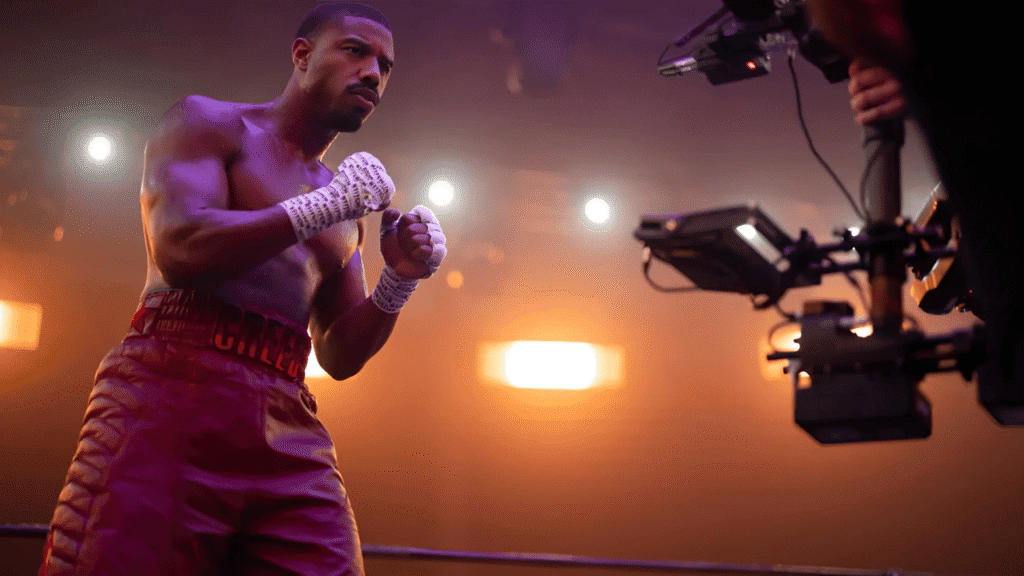
Sammie Moore, Delroy Lindo and Michael B. Jordan in Sinners
 The Academy Awards are still three weeks away, but this is a vital week for the contenders. We’re approaching the end of campaigning, with the final Oscar voting opening on Feb. 26 and closing March 5. In between those dates are two key precursors: the Producer’s Guild Awards on Feb. 28 and the Actor Awards (formerly the SAG Awards) on March 1. Both events have strong—though not infallible—track records of foretelling the eventual Oscar winners.
If Sunday’s BAFTAs ceremony proved anything, it’s that surprises and upsets can still happen. I’m not talking about the controversy that overshadowed the ceremony when John Davidson, the subject of the narrative film I Swear—which picked up best actor for Robert Aramayo, besting Oscar nominees in Timothée Chalamet, Leonardo DiCaprio, Ethan Hawke, and Michael B. Jordan—shouted a racial slur from the audience while Jordan and his Sinners co-star Delroy Lindo presented the first award of the night. The Scottish Davidson, who at 16 was the subject of a documentary film John’s Not Mad, is the U.K.’s most recognizable advocate for Tourette syndrome awareness and was invited to the event to celebrate the film based on his own life.
The moment was naturally unsettling and unfortunate. That the BBC aired it in full during the broadcast two hours after the ceremony ended only exacerbated the issue, particularly as the broadcast cut short My Brother’s Shadow director Akinola Davies Jr.’s acceptance speech for outstanding debut by a British writer, director, or producer, which included the phrase “free Palestine.” (That is somehow more offensive than the N-word?) I feel bad for Jordan, Lindo, and Davidson and believe that the BAFTA and the BBC failed all three in this sad situation. (For a deeper dive into this ordeal, I recommend my former colleague Rebecca Sun’s take on the matter.)
Most people are understandably more focused on the BAFTA scandal than they are on the BAFTA winners. But Sunday’s awards still threw a few wrenches into the awards-season machine beyond Aramayo’s surprise win for best actor.
One Battle After Another led the BAFTA winners, collecting six prizes, including the expected ones for best picture, director, and adapted screenplay. More surprising was Sean Penn’s win for best supporting actor; Penn wasn’t there, so perhaps he didn’t expect it, either. The film also earned two crafts prizes for best cinematography and editing.
Sinners followed One Battle’s lead with three wins. Wunmi Mosaku collected her second major prize of the season for best supporting actress (she won the Gotham Award in December for best supporting performance), beating out One Battle’s Oscar frontrunner Teyana Taylor. Meanwhile, Ryan Coogler made history as the first Black winner in the original screenplay category, and Ludwig Göransson won for his score. Also winning three awards was Frankenstein, taking best costume design, makeup and hairstyling, and production design—all signs that Guillermo del Toro’s passion project will collect the corresponding Oscars.
Hamnet, which currently looks like it’ll win a single Oscar, for Jessie Buckley’s lead performance, took advantage of the home field and also won a BAFTA for best British film. At this point, Buckley is the only acting contender who seems to have her Oscar in a lock.
The Actor Awards may not bring much clarity to those races. Sentimental Value’s Stellan Skarsgård is absent in SAG’s supporting actor category (in fact, no non-English performances were nominated in any category), so it’s difficult to say how that may impact the Academy’s supporting race—or if Penn will collect another trophy next weekend. Despite SAG’s massive membership overlap with the Academy, which counts actors as the biggest voting block, there have been too many discrepancies between the two awards bodies’ winners to make it the final Oscar bellwether. Last year, both A Complete Unknown’s Chalamet and The Substance’s Demi Moore won SAG Awards and then lost the respective Oscars, and the year before saw Killers of the Flower Moon’s Lily Gladstone win the SAG Award for best actress while Poor Things’ Emma Stone won the Oscar.
The PGA Awards, however, are more reliable when it comes to the best picture outcome. Since 1989, when the Producers Guild presented Driving Miss Daisy with its top honor, the PGAs have predicted the Oscar best picture all but 10 times—most recently in 2020, when the guild chose 1917 over Parasite. Of all of the ceremonies in this season, the Feb. 28 PGA Awards is the most crucial when it comes to predicting cinema’s biggest honor of the year.
Ultimately, I think the twists and turns in this year’s race are a good thing. Isn’t it more exciting to go into an Oscars ceremony with a sense of anticipation? And despite all of its wins going forward, I have a sneaking suspicion that One Battle After Another might not be a shoo-in for best picture. Sinners is hot on its heels, with a record-setting 16 Oscar nominations as proof that there’s a lot of love for the film across the Academy. The BAFTAs incident may very well rally more support behind it.
The game isn’t over until that final envelope is opened. Contenders tell themselves that every year, but this season it’s true.