There was something interesting Sreeram Raghavan said about war movies during the promotions of his latest movie, Ikkis. He said that every great war movie is, in fact, an anti-war movie. And if you look at the 1997 film Border by JP Dutta, even though it was built around this patriotic emotion of protecting your motherland, it wasn’t a hate-mongering movie that celebrated war. The end-credit song of that movie was about a future where there would be no war between India and Pakistan, and both countries would prosper. And it also documented the countless lives lost on both sides. After nearly three decades, when a sequel was announced with a new cast and a new director, I had all the reasons to believe that Border 2 might well end up like a hyper nationalistic Pakistan bashing film since the climate was in favor of such sentiments. But to my surprise, this sequel from Anurag Singh maintains the anti-war sentiment of the JP Dutta film.
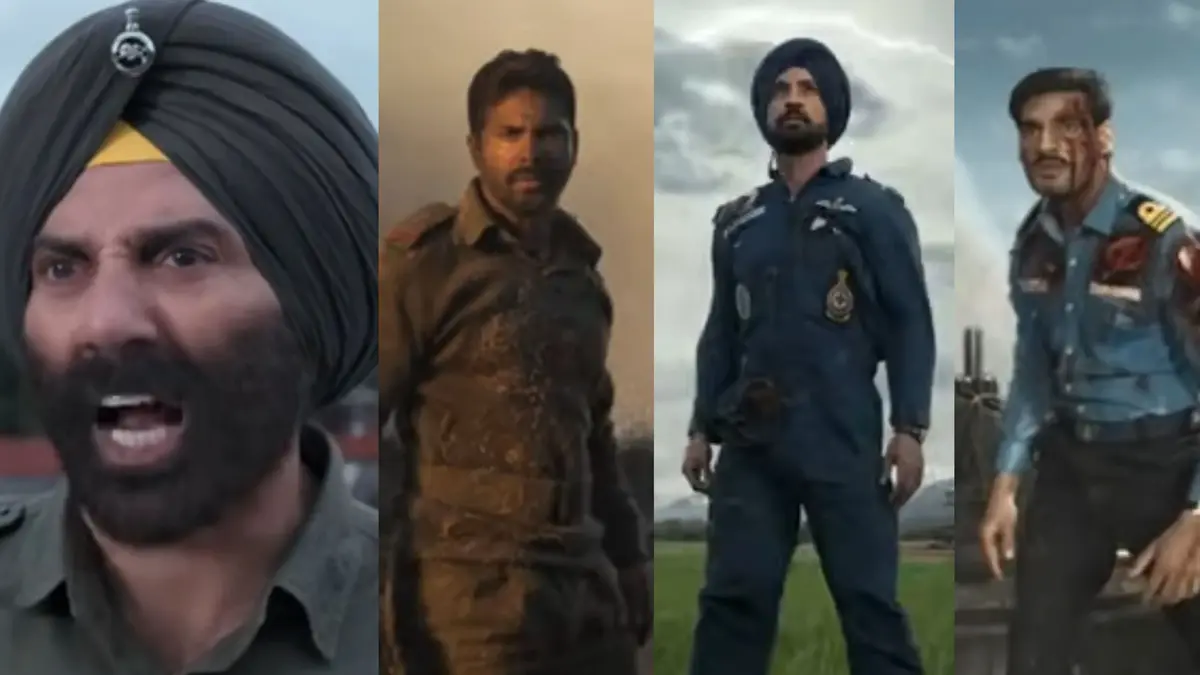
So the story this time is happening in the same timeline as the 1997 movie. The 1971 war was not restricted to one particular zone, and all branches of our military, the army, navy, and air force, took part in it. While we saw what happened in Longewala in the movie Border, what we see here are the battles fought on land, sea, and air by the Indian military during the 1971 war. And we see that through the stories of four officers in the force.
Technology has advanced significantly, and compared to 1997, now filmmakers can use the help of CGI to capture war in the air and sea. Border 2 is basically an elaborate version of the first movie. And since the story and elements in Border are very iconic among the audience, they have basically shuffled all of that and assigned it to various characters. The traits, tropes, and story elements we have seen in Border are getting allotted to new characters. Things that were in the Akshaye Khanna story are shared between the Sunny Deol track and the Varun Dhawan track in this one. So in a way, they are trying to cash in on the popularity of the first film rather than creating something entirely new.
The movie has a run time of 199 minutes, and the first half of the movie, which is almost 90 minutes, is basically showing the backstory of the main four characters. Unlike the first movie, the backstory has a lot of humor, and thanks to a lively Diljit Dosanjh, even the tacky humor around a punishment felt interesting. After setting up all the backstories in the first half, the film enters the unending war sequences in the second half. The air force and navy tracks, which require a lot of CGI, are not getting much screen time. While the CGI in the sea war wasn’t that great visually, the air force sequence had a better feel. Much like the 1997 movie, the fight of the army is getting the prominent space in the screenplay, and it was good to see them using less CGI. When you rewatch Border today, there is a cheesy feel in some of the patriotic dialogues that might not work today, and when it comes to Border 2, they have managed to lower it to an extent.
Sunny Deol is playing a different character this time, and the character’s name is Fateh Singh. The typical screaming of Sunny Deol is happening here, and he is not playing a younger version, as we see him as the father of a soldier who gave his life for the country. The smirky expression of Varun Dhawan may have garnered him a lot of trolling. But barring that recreation of the iconic song, he isn’t really using that trolled expression. The classic Varun Dhawan running, which we see in the first half, is unintentionally funny. But when it comes to those fiery speeches in the second half of the movie, he had that energy in him to be on the same page with someone like Sunny Deol. Diljit Dosanjh is actually pretty fun to watch in the first half of the movie, where it has a lot of humorous elements. His ease and comedic timing play a key role in making all those characters endearing. Ahan Shetty is not able to create much of an aura through his performance. Many of the traits associated with his Dad’s character in the original movie are being given to him, and that felt like an easter egg fan service moment. Much like the first movie, the women don’t have much to do here, other than sending their men to war with teary eyes.
The writing by Sumit Arora and Anurag Singh has actually used some of the elements from the recent past in this movie about the 1971 war. There is one instance in the film where the three soldiers are in a huddle, and Diljit goes, “let’s give them hell”, which was actually said by Virat Kohli during a test match. And there is a story about a diya in this movie narrated by the character played by Anurag Arora. That is actually a portion from a stand-up set by Varun Grover. Hoshiyar Singh, the character played by Varun Dhawan, is based on a real soldier, and Major Sahadevan, played by Mohanlal in 1971 Beyond Borders, was also based on the same soldier. At one point in the climax, they have used the bond Hoshiyar Singh had with a soldier from the other side to show the brutal side of war, where we realize that even the enemy soldier has a family, and he is also doing this just like our soldiers. Border 2 is not blowing your mind with a fresh narrative. But it clearly relaxes you with less toxicity.