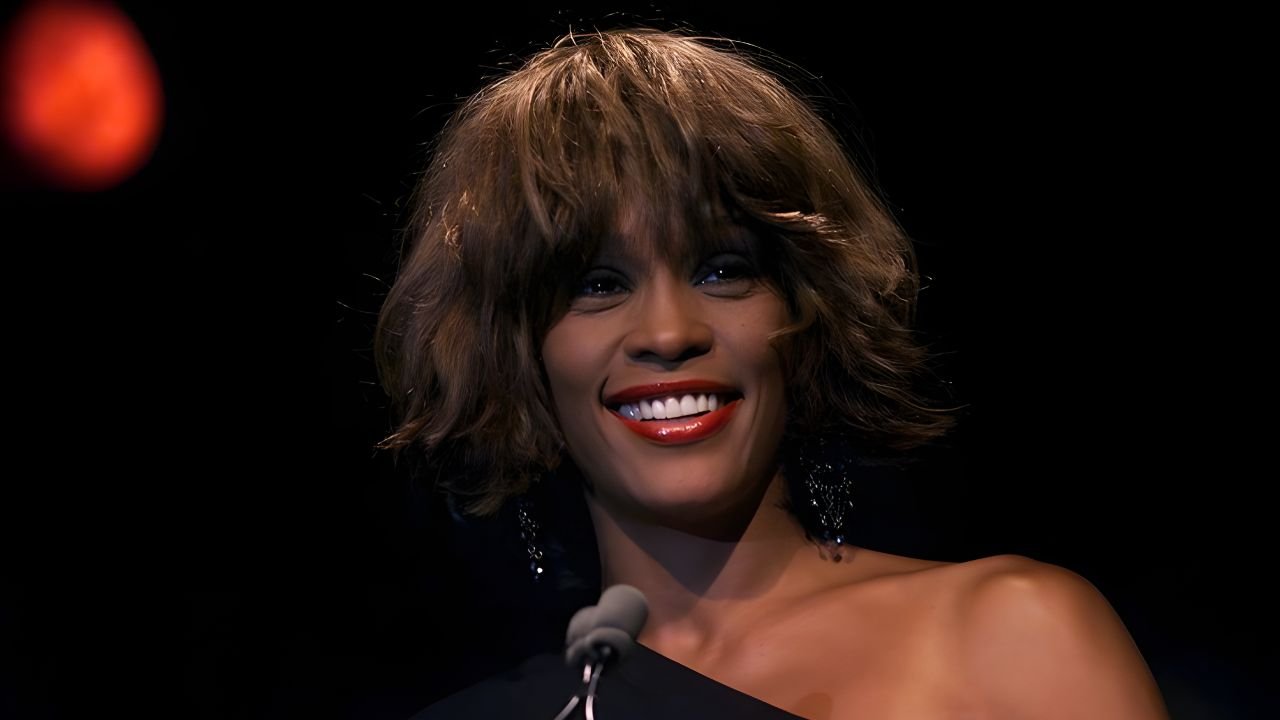
Few voices have ever stopped the world in its tracks like Whitney Houston’s. Her sound was thunder and velvet, a blend of gospel fire and pop perfection. She was crowned “The Voice,” selling over 200 million records and redefining what it meant to be a global superstar. Yet behind the perfection of her music was a woman carrying unbearable struggles — a soul as fragile as it was luminous. Her story is one of unmatched triumph, haunting sorrow, and a legacy that will never fade.
Gospel Roots: A Voice Born in the Church
Whitney Elizabeth Houston was born in Newark, New Jersey, in 1963, into a family of music royalty. Her mother, Cissy Houston, was a renowned gospel singer, and her cousins included Dionne and Dee Dee Warwick. Music was not just an option; it was her inheritance. By age 11, Whitney was already singing solos at New Hope Baptist Church, where her voice soared through hymns with a power far beyond her years.
From those pews, a young Whitney carried with her the gospel spirit that would define her career. Unlike many pop stars, she didn’t just sing notes — she sanctified them, turning every ballad into a sermon of love, faith, and heartbreak.
The Meteoric Rise: From Model to Superstar
In her teenage years, Whitney was discovered not only for her voice but for her beauty. She modeled for magazines like *Seventeen*, becoming one of the first Black women to grace its cover. But it was Clive Davis, the legendary record executive, who recognized her once-in-a-lifetime talent. Under his mentorship, she released her debut album *Whitney Houston* in 1985, which became an instant classic.

Her first two albums delivered seven consecutive number-one hits, a record that still stands. Songs like *How Will I Know*, *Greatest Love of All*, and *I Wanna Dance with Somebody* became global anthems, establishing her as the premier voice of her generation.
The Bodyguard Era: A Voice That Defined a Generation
In 1992, Whitney reached a new height with *The Bodyguard*. Paired with Kevin Costner, the film was a smash hit, but it was the soundtrack that became legendary. Her rendition of Dolly Parton’s *I Will Always Love You* became the best-selling single by a female artist in history. It wasn’t just a song; it was a cultural moment. That soaring acapella opening note is still instantly recognizable, a sound that feels eternal.
Whitney had become not only a singer but a symbol: of possibility, of Black excellence, of the transcendent power of music.
The Struggles Behind the Spotlight
But as her star burned brighter, her private life grew darker. Fame brought pressures few could endure, and Whitney faced a relentless spotlight. Her marriage to Bobby Brown was filled with turbulence, marked by love, chaos, and controversy. Addiction began to take hold, turning one of the greatest voices into a cautionary tale. Interviews in the 2000s showed a woman worn down by years of struggle, yet still yearning for redemption.
Her battles were not just with substances, but with the crushing expectations of perfection. The world saw her as untouchable, but Whitney was human — sensitive, vulnerable, and often lonely at the top of the charts.
The Final Years and Tragic Loss
In the late 2000s, Whitney attempted a comeback. Her 2009 album *I Look to You* showed glimpses of the old brilliance, a voice weathered by time but still full of soul. She spoke of second chances, faith, and resilience. Yet behind the hopeful lyrics, the weight of her struggles persisted.
On February 11, 2012, Whitney Houston was found lifeless in a Beverly Hills hotel bathtub, just hours before she was set to attend a pre-Grammy party. The world mourned not just the loss of a star, but of a woman who had given everything she had — and more — through her music.
A Legacy That Still Sings
Even in death, Whitney Houston’s voice lives on. Her songs continue to fill weddings, graduations, and quiet moments of solitude. Artists across generations cite her as an inspiration, from Mariah Carey to Beyoncé. Her influence is felt not only in the charts but in the way she broke barriers for women of color in the music industry, proving that excellence knows no limits.
The 2018 documentary *Whitney* revealed the complexities of her life — the triumphs, the heartbreaks, the fragility behind the icon. And yet, through it all, one truth shines: Whitney’s voice was not just a gift to her generation, but to all time.
Final Reflection: The Song That Never Ends
Whitney Houston’s story is not simply one of tragedy, but of humanity. She showed us that even angels can stumble, that even the most powerful voices can tremble. Her legacy reminds us that greatness does not mean flawlessness; it means giving the world your gift, even when it costs you everything.
When we hear her sing *I Will Always Love You* or *Greatest Love of All*, we are reminded of the fire and fragility within her. She carried both heaven’s music and earth’s sorrow. And though she is gone, the echo of her voice is eternal.
Further Reading: Discover our tribute to voices that shaped generations or explore our feature on icons of music and legacy.